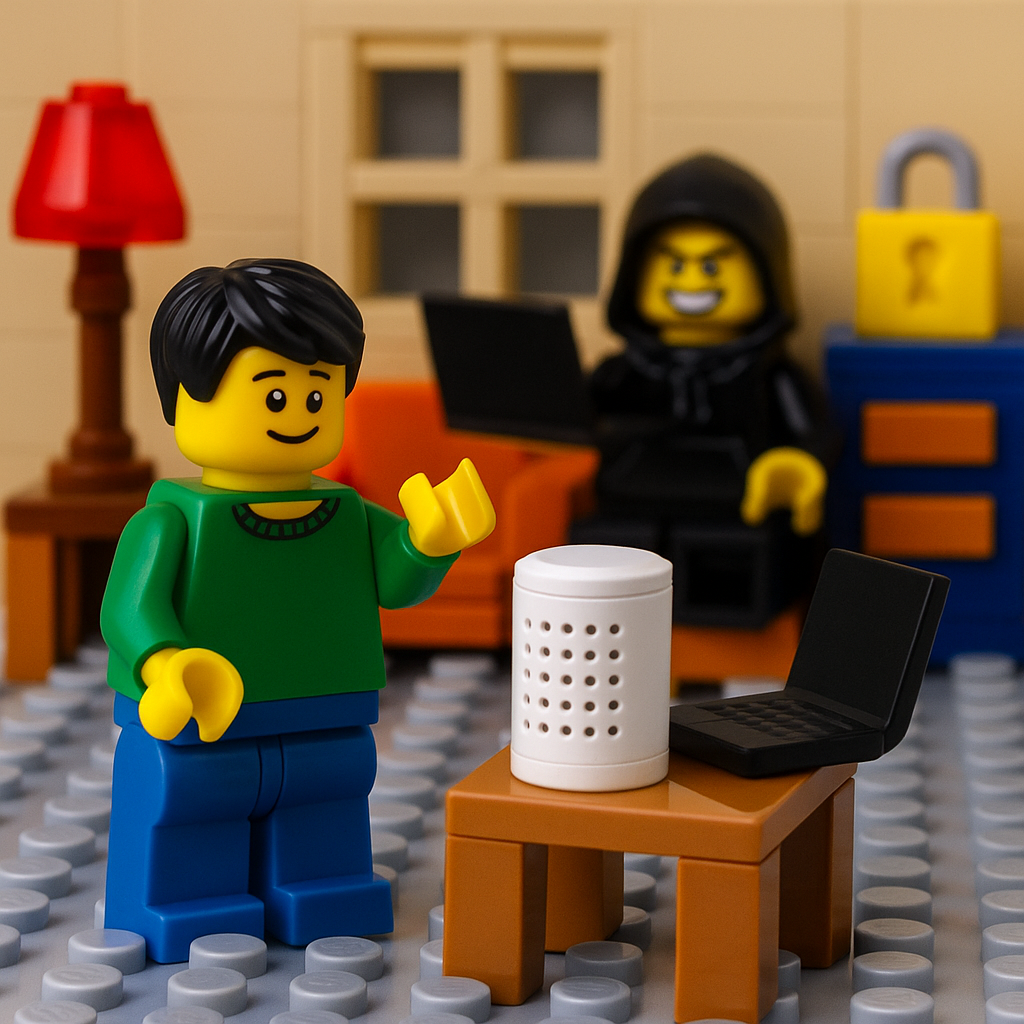
When Alexa Becomes the Hacker’s Accomplice
You ask Alexa to turn on the light… and she says “Ok.”
But imagine if, secretly, she also sent your Wi-Fi password to a stranger on the other side of the world. Welcome to the not-so-reassuring world of IoT (Internet of Things), where your smart devices can become accidental spies.
📡 Connected devices are convenient… but not always smart
Your fridge that orders milk by itself.
Your vacuum that maps your entire home.
Your “low-cost” security camera streaming directly… to China.
The problem? Many of these gadgets come with default passwords that no one ever changes.
Result: hackers scan the Internet and find thousands of devices left wide open like doors without locks.
🎭 How hackers exploit IoT
Hacked cameras: they watch you without your knowledge.
Botnets: your toaster becomes a soldier in a zombie-machine army (example: the Mirai attack in 2016).
Data theft: your thermostat reveals your daily routines (perfect for knowing when you’re on vacation).
🛡️How to stop your toaster from becoming a spy
Change default passwords (seriously, “admin/admin” is a joke).
Update the firmware (yes, even your fridge needs updates).
Separate your Wi-Fi network: one for smart devices, one for your computer.
Avoid super-cheap gadgets: if it’s free—or almost—it usually means you’re the product.
📖 A chilling real-world example
In 2018, a casino got hacked… through the connected thermometer of an aquarium.
Hackers used that entry point to access the VIP customer database.
Result: jackpot.
🚀Conclusion
Smart devices are cool, but if you don’t secure them, you’re basically handing a microphone, a camera, and a backdoor to the first hacker who drops by.
At OBI Partner, we like to say:
“A connected fridge is nice. A hacker-proof fridge is better.” 🧊🔒
👉 Prochain épisode : “Deepfake Show – when your boss isn’t really your boss.” 🎭